
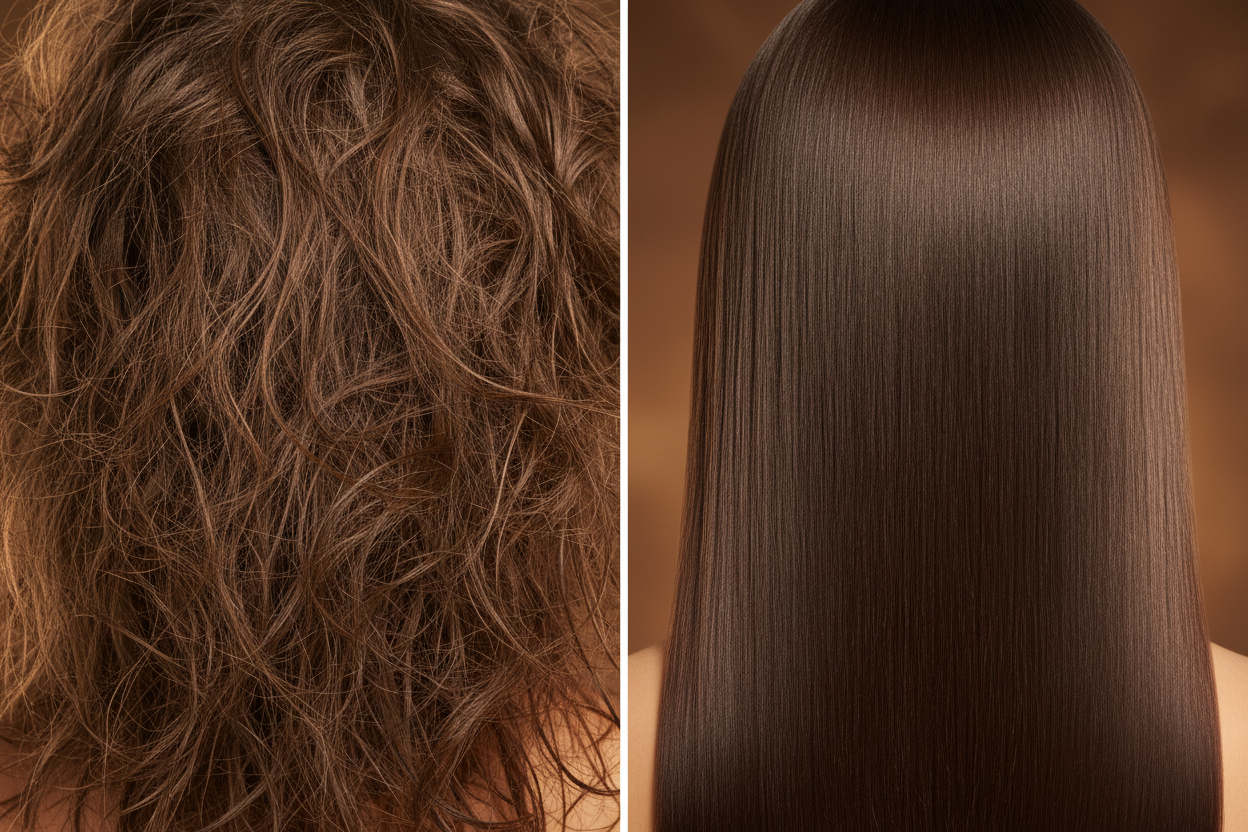
You've conditioned your hair. You've tried a hair mask. Maybe you've even switched shampoo. Yet your hair still feels dry, rough, frizzy or impossible to manage.
So, why is your hair so dry?
The answer isn't always as simple as not using enough conditioner. Dry hair can be caused by everything from your washing routine and heat-styling habits to bleaching, chemical treatments, environmental exposure, and your natural hair type. In some cases, what feels like dryness may also be a sign that your hair is damaged and needs more than moisture alone.
Understanding what's causing the problem is the first step towards finding the right dry hair treatment.
Below, we'll explore 10 common causes of dry hair, how to recognise the difference between dry and damaged hair, and how to build a haircare routine that brings back softness, shine and manageability.
What Causes Dry Hair?
Healthy-looking hair depends on maintaining the right balance of moisture and protection.
The outer layer of the hair, known as the cuticle, helps protect the internal structure of each strand. When hair struggles to retain enough moisture or the cuticle becomes compromised, the result can be hair that feels dry, rough and difficult to manage.
Common signs of dry hair include:
- Frizz and flyaways
- Rough texture
- Dullness
- Lack of shine
- Tangling
- Dry ends
- Reduced softness
- Brittle-feeling strands
However, identifying that your hair is dry is only half the battle. To fix dry hair effectively, you first need to understand what's causing it.
1. You're Washing Your Hair Too Often
Washing your hair is essential for removing excess oil, styling products, sweat and environmental buildup. However, washing too frequently may leave some hair types feeling dry.
Every scalp naturally produces oils that help protect and condition the hair. Frequent cleansing, particularly with products that aren't suited to your hair type, can remove these oils faster than they can travel through the hair.
There's no universal rule for how often you should wash your hair. The right frequency depends on factors including:
- Your hair type
- Scalp oil production
- Exercise habits
- Styling products
- Lifestyle
Someone with a naturally oily scalp and fine hair may need to wash more frequently than someone with coarse, curly or naturally dry hair.
If your hair feels particularly dry after washing, consider whether you're cleansing more often than your hair actually needs.
2. You're Using the Wrong Shampoo
Sometimes, the problem isn't how often you wash your hair. It's what you're washing it with. Shampoos are formulated for different hair and scalp concerns. A shampoo designed to provide intensive cleansing may be ideal for someone experiencing excess oil or product buildup but less suitable for hair that's already very dry.
When choosing a shampoo for dry hair, consider your complete hair profile.
Is your hair:
- Bleached?
- Colour-treated?
- Curly?
- Coarse?
- Fine?
- Chemically processed?
- Also damaged?
The answer can help determine which products are most appropriate.
Professional haircare brands such as NAK Hair offer shampoos formulated for different hair types and concerns, allowing you to build a routine based on what your hair actually needs rather than taking a one-size-fits-all approach.
3. You're Not Conditioning Properly
If shampoo cleanses your hair, conditioner helps restore softness and manageability. Skipping conditioner can leave already-dry hair feeling even rougher, particularly through the mid-lengths and ends.
When conditioning, concentrate the product where your hair needs it most. For many people, this means applying conditioner primarily through the mid-lengths and ends rather than heavily coating the roots.
Leave the product on your hair for the recommended time before rinsing thoroughly. Regular conditioning can help:
- Improve softness
- Reduce tangling
- Increase manageability
- Control frizz
- Enhance shine
For a consistent routine, consider pairing your shampoo with a complementary conditioner designed for the same hair concern.
4. You're Using Too Much Heat
Hair dryers, straighteners, curling irons and hot brushes have transformed the way we style our hair. Unfortunately, regularly exposing hair to unnecessarily high temperatures can contribute to dryness and damage.
Heat styling may leave hair feeling:
- Rough
- Brittle
- Dry
- Frizzy
- Difficult to manage
You don't necessarily need to stop heat styling altogether. Instead, focus on using heat more carefully. Try using the lowest effective temperature for your hair type and avoid repeatedly passing a straightener or curling iron over the same section.
When possible, you can also allow your hair to partially air dry before finishing with a hair dryer.
5. You're Not Using Heat Protection
If heat styling is a regular part of your routine, heat protection should be too. A heat protectant creates an additional layer between your hair and the heat generated by styling tools.
Heat protection should be considered before using:
- Hair dryers
- Hair straighteners
- Curling irons
- Hot brushes
Choose a product suitable for your hair type and follow the application instructions carefully. Professional styling ranges, including products from brands like NAK Hair, offer options that combine styling benefits with heat protection, making them easy to incorporate into your everyday routine.
Protecting your hair before styling is much easier than continually trying to manage dryness and damage afterwards.
6. Bleaching and Colouring Have Increased Your Hair's Porosity
If you've ever wondered why the ends of your hair are so dry despite using conditioner, your colour history could be part of the answer.
Chemical treatments such as bleaching and permanent colouring can alter the structure and porosity of the hair.
More porous hair may absorb moisture quickly but struggle to retain it, leaving the hair feeling dry again soon after washing.
Repeated bleaching, overlapping chemical services and significant colour transformations may increase this effect.
This is where dry hair and damaged hair can begin to overlap.
If your hair is both dry and showing signs of weakness or breakage, you may need a routine that combines hydration with targeted strengthening or repair treatments.
7. Your Hair Needs More Than Everyday Conditioner
Regular conditioner is an important part of a dry hair routine, but sometimes your hair needs additional support. This is where more intensive products can help.
Depending on your hair type and condition, you might introduce:
- Hydrating hair masks
- Deep-conditioning treatments
- Leave-in conditioners
- Hair oils
- Targeted hair treatments
A hair mask for dry hair can provide more intensive conditioning than your everyday conditioner and may be particularly beneficial for dry mid-lengths and ends. Many people choose to incorporate a mask once a week, although the ideal frequency depends on the specific product and your individual hair needs.
8. The Environment Is Drying Out Your Hair
Sometimes, your haircare routine isn't entirely to blame. The environment can also affect how your hair looks and feels.
For Australians in particular, common factors include:
- Sun exposure
- UV exposure
- Salt water
- Chlorinated pools
- Hot weather
- Wind
- Air conditioning
A summer spent swimming at the beach or in chlorinated pools can leave hair feeling noticeably different by the end of the season. Consider protecting your hair before swimming, rinsing after exposure to salt or chlorine and maintaining a consistent conditioning routine.
Hair that is regularly exposed to the Australian climate may also benefit from additional leave-in care and protection.

9. Your Hair Type Is Naturally Prone to Dryness
Dry hair doesn't automatically mean damaged hair. Some hair types are naturally more prone to dryness than others.
Curly, coily and coarse hair can sometimes feel drier because natural oils produced by the scalp may take longer to travel down the length of the hair. This means the mid-lengths and ends may require additional moisture even when the hair itself is otherwise healthy.
Depending on your hair type, you may benefit from:
- Less frequent cleansing
- More nourishing conditioners
- Regular hair masks
- Leave-in hydration
- Hair oils
- Gentle styling practices
The key is recognising the difference between hair that is naturally dry and hair that has become damaged through chemical processing or excessive styling.
10. Your Haircare Routine Doesn't Match What Your Hair Needs
One of the most common mistakes people make when dealing with dry hair is assuming that more moisture is always the answer.
Sometimes it is, but not always.
Hair that feels dry, rough and frizzy may benefit primarily from moisture. However, hair that is also:
- Breaking
- Weak
- Excessively stretchy
- Chemically compromised
may require additional strengthening support.
This is where understanding the balance between protein and moisture becomes important.
Dry Hair vs Damaged Hair: What's the Difference?
Although the terms are sometimes used interchangeably, dry hair and damaged hair aren't necessarily the same thing.
|
Dry Hair |
Damaged Hair |
|
Rough texture |
Increased breakage |
|
Frizz |
Split ends |
|
Dull appearance |
Weak strands |
|
Lack of softness |
Poor elasticity |
|
Dry-feeling ends |
Excessive stretching when wet |
|
May need additional moisture |
May need strengthening and moisture |
It's also possible for hair to be both dry and damaged. For example, repeatedly bleached hair may experience increased porosity, moisture loss and structural weakness simultaneously.
In this situation, simply applying increasingly rich moisturising products may not address every aspect of the problem.

How to Fix Dry Hair
Once you've identified what's contributing to your dryness, you can start building a routine that better supports your hair.
Step 1: Choose the Right Shampoo
Select a shampoo designed for your hair type and primary concern. If your hair is already very dry, consider a more nourishing cleansing option.
Step 2: Condition Every Wash
Use conditioner consistently, focusing on the mid-lengths and ends where dryness is often most noticeable.
Step 3: Introduce a Weekly Hair Mask
Add a more intensive hydrating treatment when your everyday conditioner isn't providing enough moisture.
Step 4: Consider Leave-In Care
Leave-in conditioners and other hydrating products can help maintain softness and manageability between washes.
Step 5: Protect Your Hair from Heat
Apply appropriate heat protection before blow-drying, straightening or curling.
Step 6: Reduce Unnecessary Damage
Avoid excessive heat, aggressive towel drying and rough detangling.
Step 7: Reassess Your Routine
Haircare isn't static. Your needs may change with the seasons, after colouring or bleaching, or as your styling habits change.
Build a Dry Hair Routine with NAK Hair
If you're trying to work out how to moisturise dry hair, building a complete routine can be more effective than relying on a single product.
NAK Hair offers professional haircare solutions for a variety of hair types and concerns, making it possible to tailor your routine around what your hair actually needs.
- Cleanse: Start with a shampoo suited to dry or moisture-deprived hair.
- Condition: Follow with a complementary conditioner to support softness, smoothness and manageability.
- Deeply Hydrate: Introduce a nourishing hair mask or treatment when your hair needs additional conditioning.
- Add Leave-In Care: Use a suitable leave-in product to support hydration, detangling and manageability between washes.
- Protect: Apply heat protection before using hair dryers, straighteners, curling irons or other heated styling tools.
- Finish: Depending on your hair type, a professional serum or hair oil can help smooth the appearance of dry ends, enhance shine and control frizz.
Explore the complete NAK Hair collection at Hair & Beauty Kingdom to build a professional routine suited to your individual hair needs.
Frequently Asked Questions About Dry Hair
Why is my hair so dry even when I use conditioner?
Your hair may require a different conditioner, more intensive treatments or changes elsewhere in your routine. Excessive washing, heat styling, bleaching and environmental exposure can all contribute to persistent dryness.
Why is my hair dry after washing?
Your shampoo may be too cleansing for your hair type, you may be washing too frequently, or your hair may require more conditioning support after cleansing.
How can I moisturise extremely dry hair?
Build a consistent routine using appropriate shampoo, conditioner, hydrating treatments and leave-in care while reducing unnecessary heat and chemical damage.
What is the best treatment for dry hair?
The best treatment depends on the cause of the dryness. Hydrating masks and moisturising treatments can help dry hair, while hair that is also structurally damaged may benefit from strengthening support.
How often should I use a hair mask for dry hair?
Many people use a hydrating hair mask about once a week, though you should always follow the product's instructions and adjust the frequency based on your hair's needs.
Does dry hair need protein or moisture?
Dry hair often benefits from additional moisture. However, if your hair is also weak, breaking or chemically damaged, it may benefit from a combination of moisture and strengthening treatments.
Can dry hair become healthy again?
In many cases, improving your haircare routine can significantly improve softness, shine and manageability. However, severely damaged sections and split ends may ultimately need to be trimmed as healthier hair grows.
How Long Does It Take to Fix Dry Hair?
There's no single answer. The timeframe depends largely on why your hair is dry.
If the issue is primarily related to your shampoo, washing habits or lack of conditioning, you may notice improvements in softness and manageability relatively quickly after changing your routine.
If your hair is also significantly damaged from bleaching, colouring or excessive heat, improving its overall condition may take longer.
The most important factor is consistency. A well-balanced routine, followed consistently, will generally deliver better long-term results than using an intensive treatment once and then returning immediately to the habits that contributed to the problem.